
As disruption becomes a constant in global supply chains, visibility across every stage of a shipment’s journey is now critical for making data-backed decisions that reduce downstream impact.
Ongoing geopolitical events in the Middle East have highlighted just how quickly disruption at key choke points can ripple across interconnected global trade lanes. But while these moments capture international attention, they are only part of the story.
“It’s not just the major events that businesses need to be across. It’s all the small, non-newsworthy delays that affect operations on a day-to-day basis that freight forwarders should also have visibility over,” explains Jon Charles, Senior Product Manager at WiseTech Global.
On average across major trade lanes, 74% of containers arrived late at their destination port so far this year. On the Asia to Europe corridor, on-time performance fell as low as 14% in February.
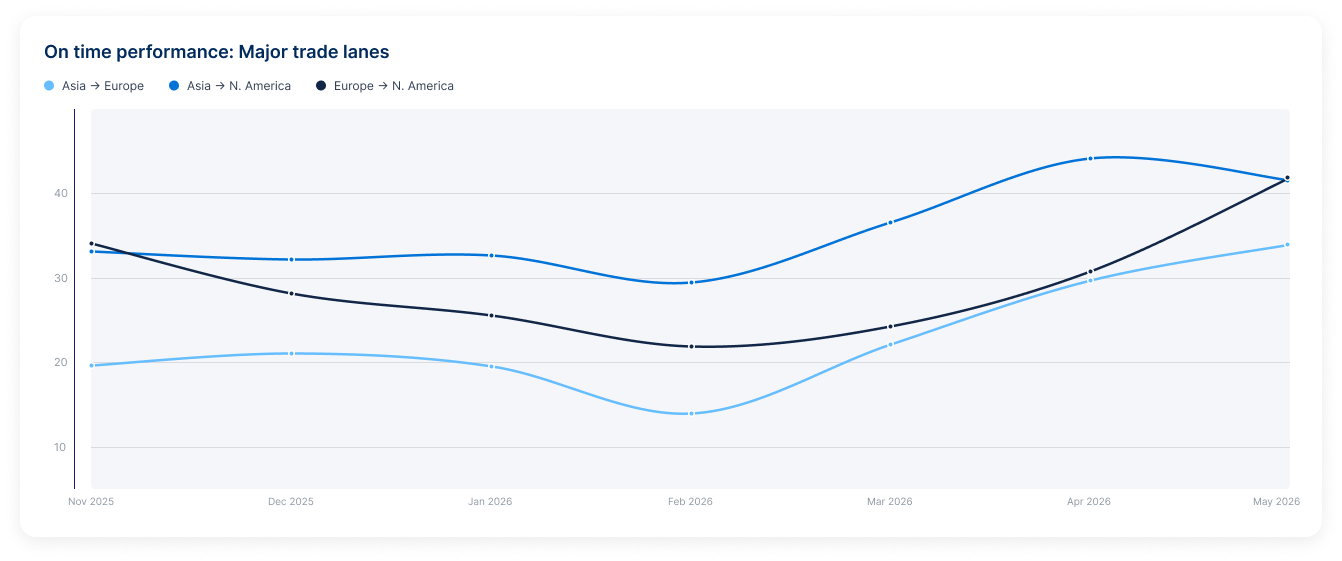
| Trade Lane | Nov 2025 | Dec 2025 | Jan 2026 | Feb 2026 | Mar 2026 | Apr 2026 | May 2026 |
|---|---|---|---|---|---|---|---|
| Asia -> Europe | 19.66 | 21.14 | 19.61 | 14.02 | 22.12 | 29.70 | 34.02 |
| Asia -> N. America | 33.22 | 32.23 | 32.72 | 29.55 | 36.59 | 44.20 | 42.59 |
| Europe -> N. America | 34.13 | 28.16 | 25.64 | 21.92 | 24.35 | 30.79 | 41.91 |
“Delays can compound and have significant cost across supply chains – but they remain largely hidden, hard to detect, and therefore manage,” says Jon.
What this means for forwarders
A one-day delay at origin may seem manageable, but when combined with further disruption at departure, transshipment or arrival, these delays can accumulate into days and sometimes weeks of extended transit time.
At scale, this creates a continuous stream of exceptions that teams must identify, understand, and respond to, often with limited time and incomplete information.
In this environment, visibility is no longer just about knowing where cargo is. It is about understanding when a shipment has deviated from plan and what that deviation means for the rest of the journey, as well as the potential impact on the customer.
Traditionally, many forwarders have relied on carrier-provided ETA and ETD updates to infer delays. This requires teams to manually compare updates against the original plan to calculate delays to the overall transit time, however, this error-prone approach can lead to further issues downstream.
As Pierre Hausken, Product Manager at WiseTech Global, notes, real-time delay visibility can make a significant difference here.
“If teams can instantly identify where delays have occurred during the journey and understand the severity of the delays, they can take action right away to ensure disruption is minimized,” Pierre highlights.
Real-time delay visibility in action
Delays can occur at any leg of a shipment’s journey, including at transshipment, where visibility is often limited.
Pierre gave the example of a recent shipment passing through the Asia to Europe trade lane this year, from Shanghai to Oslo, which saw its total transit time increase by 15 days, from 47 to 62 days, based on the updated ETA from the carrier.
“Often, we don’t know where and when the delays occurred on the journey. However, with the latest update to Cargo Tracker within CargoWise, delays at transshipment ports are clearly identified and measured.
We can see that the shipment was due to depart on April 23 but didn’t depart until the following day. While it arrived in Hamburg for transshipment an hour ahead of schedule more material disruption occurred in the second leg of the journey.”
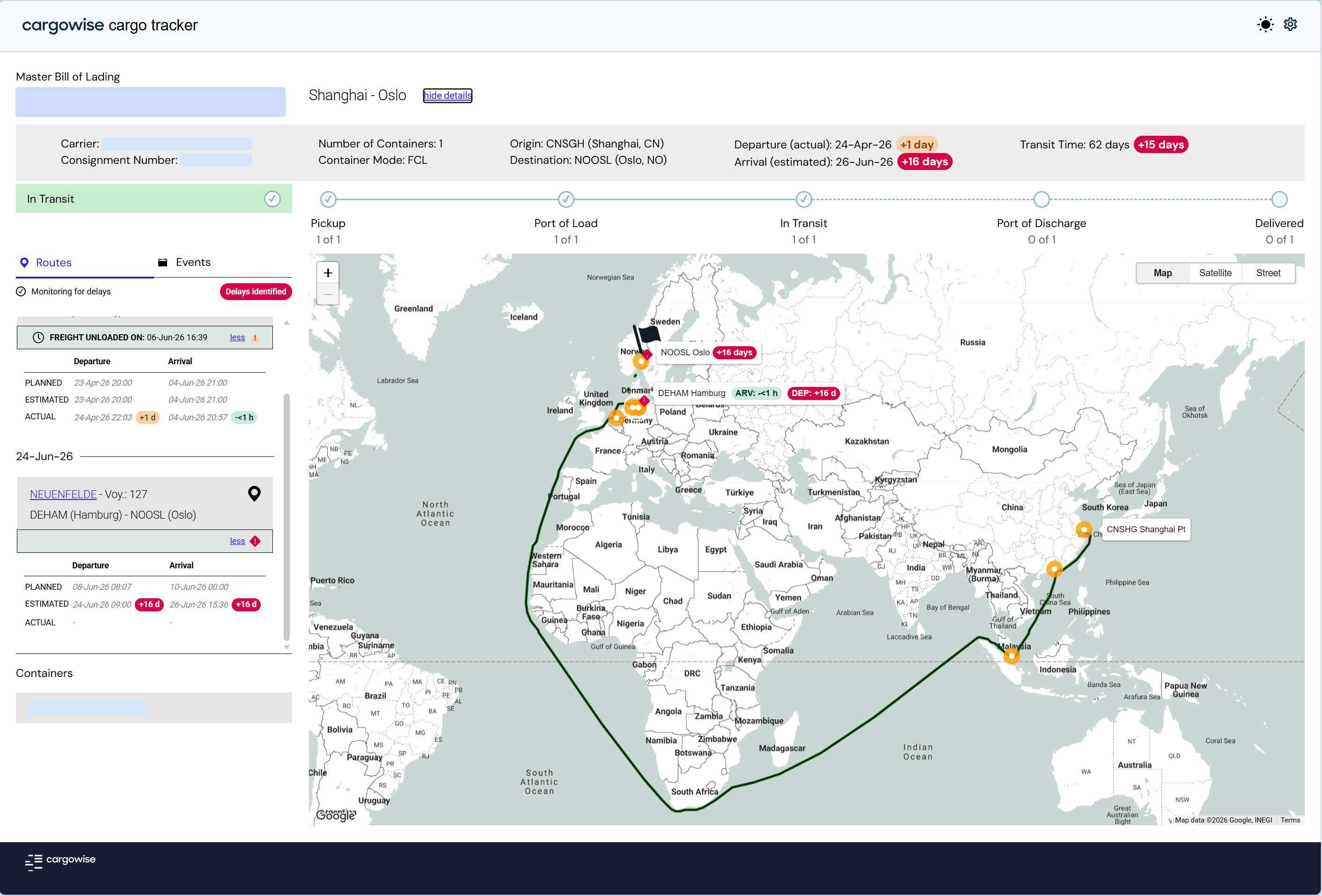
The shipment was originally due to depart Hamburg on June 8 and arrive in Oslo on June 10, but the Cargo Tracker platform shows there was a 16-day delay at transshipment, with a new expected arrival on June 26.
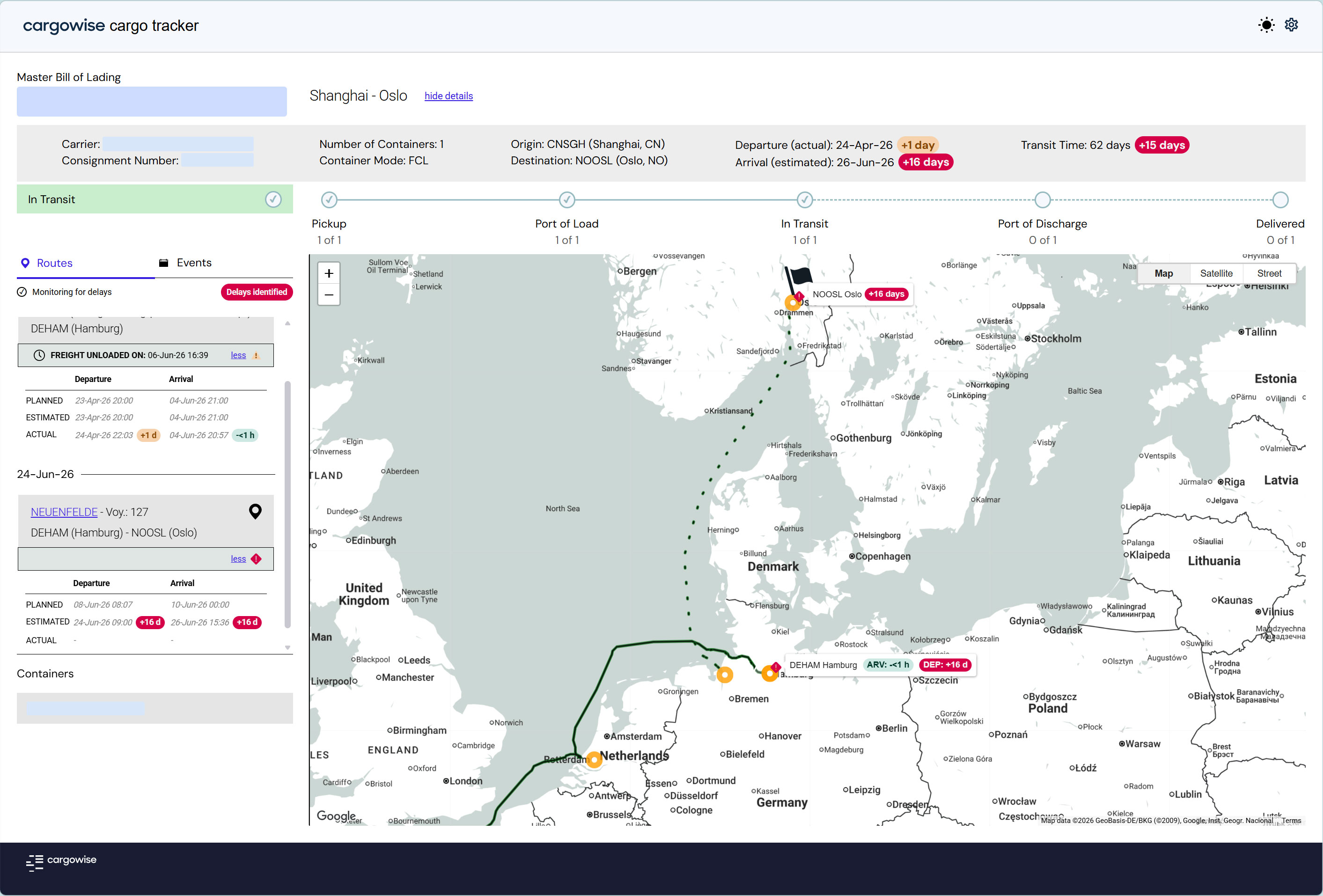
According to Pierre, “showing where delays have occurred and how they have compounded, paints a full picture of the overall shipment timeline for operators.”
What this enables for logistics teams
By turning raw tracking data into structured delay insights, this enables teams to move from reactive tracking to proactive decision-making.
With earlier and clearer information, teams can communicate more effectively with customers, partners, and internal stakeholders, building trust and credibility.
“This real-time visibility also creates time to adjust downstream planning, reallocate resources, and explore alternative options,” says Pierre.
In cases where delays have a commercial impact, Cargo Tracker provides a clearer basis for assessing service performance and supporting compensation discussions with carriers.
As Pierre adds: “Delay data on its own isn’t enough. What matters is being able to act on it in real time, before it compounds into larger operational disruption across the supply chain.”