
For freight forwarders and customs brokers, some of the most avoidable customs delays begin well before a declaration is filed. The issue may already be present when the shipment is booked: a vague product description, a missing end-use statement, or a certificate that is incomplete or incorrect. Recognizing these gaps requires specialist expertise from customs brokers or compliance professionals, who are often stretched across competing demands and only brought into the process later. By then, missing information can hold up the very work they have been brought in to do. What could have been a routine request at booking can quickly become urgent, putting customs clearance and delivery timelines under pressure.
Customs authorities see the results. In Australia, nearly a third (32%) of the import declaration lines the Australian Border Force assessed in 2024–25 contained at least one error.1 In the UK, traders interviewed for HM Revenue & Customs research identified documentation errors as “a primary cause of border checks.”2
AI creates an opportunity to bring some of that specialist expertise into earlier stages of the shipment lifecycle, helping freight forwarders and customs brokers identify information gaps before they become operational blockers. Still, the harder part is closing those gaps.
Information gaps continue to stall customs clearance
Global trade depends on information moving between manufacturers, suppliers, shippers, carriers, freight forwarders, customs brokers and government agencies.
The International Chamber of Commerce and World Trade Organization estimate a typical trade transaction can involve 36 documents and 240 copies.3 Each party contributes part of the information needed to move the goods, while the freight forwarder or customs broker must ultimately turn that information into an accurate, compliant shipment record.
That creates several recurring gaps. An upstream supplier may describe an item simply as “parts,” when classification depends on its material, function and intended use. A potential export-control issue may require an end-use statement that has not yet been collected. A certificate may be attached to the job but turn out to be unsigned, incomplete or linked to the wrong shipment.
Not every information gap is immediately apparent. A missing document is relatively easy to spot, but recognizing a potential export-control issue often requires specialist expertise that frontline teams don’t always have. If those risks go unnoticed early in the shipment lifecycle, the necessary questions may never be asked. The gaps that matter most are often the ones nobody knew to look for.
Why is chasing missing information still so manual?
Getting the information needed to progress a shipment often means reaching outside the business to a supplier, shipper or customer, and that process still relies heavily on email and phone.
The digital exchange of trade information across borders remains limited. A 2025 UN survey of 174 countries found that measures to support the electronic exchange of trade data and documents across borders were, on average, only 49% implemented.⁴
For freight forwarders and customs brokers, this may feel familiar. Someone identifies what is missing, works out who can provide it, sends a request and follows up. When the answer arrives, it needs to be checked, added to the job and passed to whoever is waiting on it. An incomplete response starts the cycle again.
“I think many businesses don't even think about this ‘stop, ask, chase’ as a process when in reality it is probably the most time-consuming and cumbersome process they operate,” says Andrew Cumming, Senior Product Manager at WiseTech Global.
Yet despite the effort involved, these requests are rarely managed as a structured operational process. They often sit in individual or shared inboxes, disconnected from the shipment record.
“The same question can get asked more than once,” Cumming explains. “Requests go out piecemeal as each issue surfaces. There’s no clean record of what was asked or what came back.”
Without a clear record, businesses have limited visibility into outstanding requests, response times and recurring information gaps. This also makes it difficult to identify where the process could be improved.
“What data does the business have to understand and optimize this process? Often it's in emails,” says Cumming.
As a result, even a basic operational question becomes difficult to answer: what is this shipment still waiting on?
The cost of missing information at clearance
The time available to resolve missing information narrows as shipment progresses. A product detail or certificate requested at booking can be obtained while the goods are in transit. When the need only becomes clear during declaration preparation or shortly before arrival, teams must chase the same answer under pressure, with clearance, delivery schedules and additional costs at stake.
Delayed or incomplete information can lead to:
Clearance delays: declarations may not be ready to file, or additional checks and clarifications may be needed before goods can move.
Demurrage and detention costs: Once the free time runs out, these shipments accrue charges that can run into several thousand dollars per container, depending on location and commodity.
Penalties: customs authorities can fine an inaccurate declaration even when the error is an honest mistake, and the amount often rises with the duty at stake.
Delivery disruption: missed clearance windows can put onward transport and customer commitments under pressure.
More manual effort: operations teams spend additional time chasing answers, reconciling responses and escalating issues.
The compliance exposure can be larger still.
In December 2023, five US government agencies issued a joint compliance note stating that freight forwarders and other agents acting on behalf of principal parties are also responsible for the representations they make when filing export control documents.5 The note also advised transportation companies to verify the true nature, origin and destination of the cargo they handle.
Missing information does not remove that obligation. It makes it harder to meet.
The earlier a gap is identified and resolved, the more time teams have to act before it becomes a clearance, cost or compliance problem. Spotting it sooner helps only if someone can act on it and close it in time.
Taking AI from research to resolution
AI can already reduce the time and effort needed to research and check shipment information before a customs declaration is prepared.
Individual AI agents can search manufacturer and supplier sources to understand a product, screen commodities for potential compliance risks, and review documents to check whether they contain the information expected, but some answers do not exist in the available data.
A technical specification may only be held by the manufacturer. The intended end use of a product may only be known by the importer. A signed certificate may still be sitting with the supplier. AI cannot infer those details with confidence, nor should it. When several agents each find a different gap on the same shipment, they flag them separately, so the questions still reach the supplier one email at a time and the response never lands back on the job.
The challenge, then, is not simply whether AI can identify that something is missing. It is whether the workflow can take the next step: determine who holds the answer, request it, validate what comes back and return that information to the job.
This is where AI can create more practical value for freight forwarders and customs brokers by helping them close the loop from detecting an information gap to resolving it within the same operational workflow.
How can connected AI agents close information gaps across the customs workflow?
Different AI agents can uncover different gaps across the same shipment, but the bigger opportunity is connecting those agents so they can obtain what they need and continue the work.
CargoWise is taking this approach by embedding specialist AI capabilities into the workflows freight forwarders and customs brokers already use.
This is how coordinated CargoWise AI capabilities can help close information gaps during customs preparation.
Product Research Agent identifies goods from the invoice line using supplier and manufacturer websites, catalogs and datasheets. When those sources aren't enough to classify a line, it asks the supplier for technical specifications.
ComplianceWise screens parties and commodities against the control lists in BorderWise, CargoWise's border compliance engine. When it can't assess a risk, it asks for an end-use statement or the goods' export control status.
Document Validator checks each uploaded document against the rules for its document type. When one isn't what it should be, it asks for the correct version.
Smart Auto Request Agent bundles those questions into one request for each party, sends it and brings the answers back to the job.
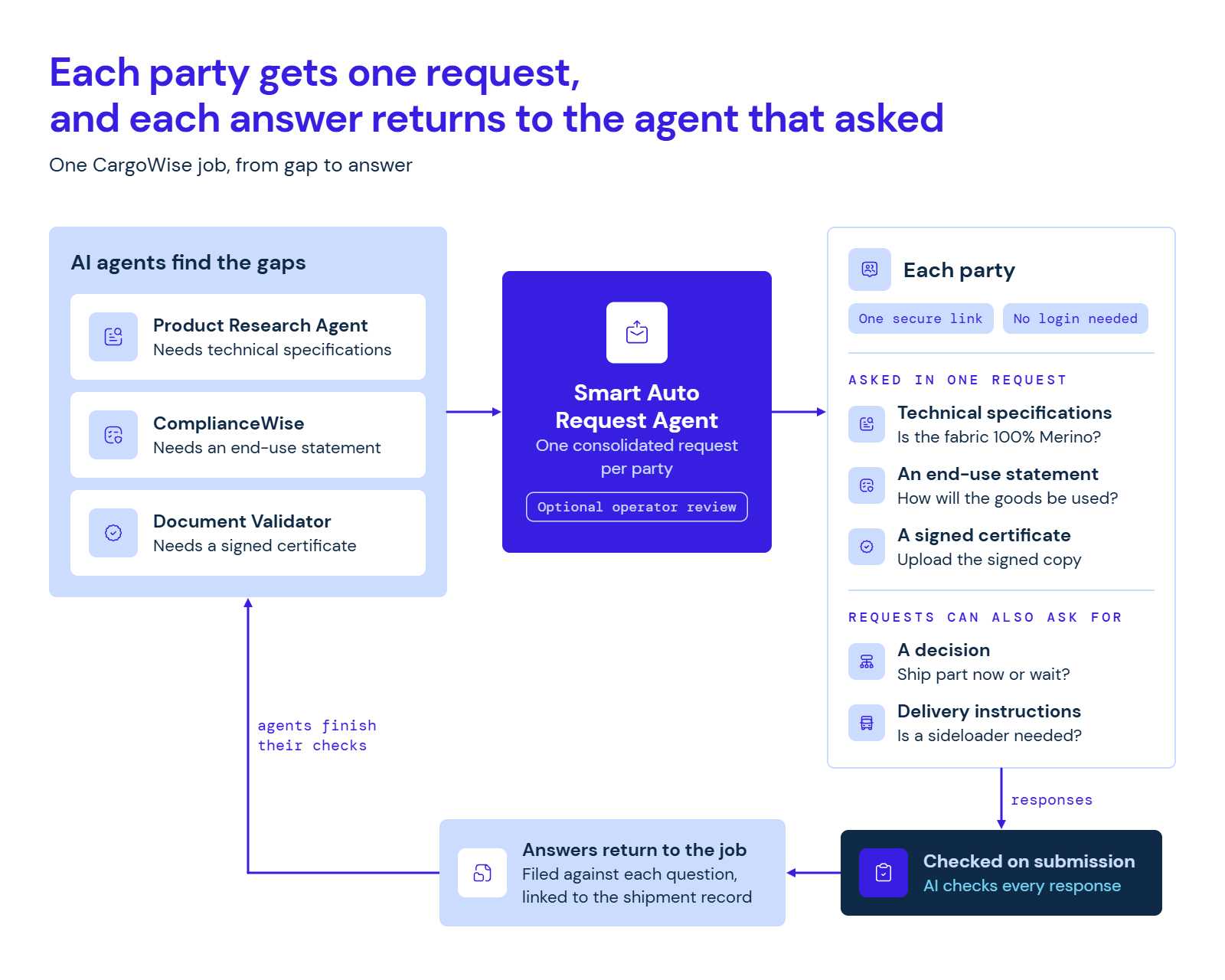
If several checks uncover questions for the same supplier, those questions can be consolidated into a single request rather than separate email chains. The supplier responds once, the information returns to the job, and the agents waiting on it can continue their work.
The agent also determines who is best placed to answer each question, including routing requests through the agent at origin when the supplier cannot be reached directly. Scheduled follow-ups and escalation of overdue responses reduce the need for teams to chase answers manually.
Whether a reply arrives through the portal or by email, each answer is matched to the question that prompted it, allowing the agents waiting on that information to continue their checks.
This follows a broader principle we explored in AI alone won't transform your supply chain. The data beneath it will: enter data once, enter it accurately, and allow it to flow end to end across the shipment lifecycle.
An answer captured through a request does not just close the immediate gap. It becomes part of the operational record and can provide evidence and context for the next check or decision in the workflow.
How much should an AI agent do on its own?
In logistics, letting AI act on a shipment or contact an external party is a trust decision. The level of automation should therefore be configurable, with people able to review and approve actions where judgment is required.
In CargoWise, the business sets those controls:
Approving requests: requests raised by an AI agent start as drafts for an operator to approve before they are sent. Operators can also create rules to auto-approve requests.
Reviewing responses: for each request type, the business decides whether an answer is accepted on arrival, accepted after an AI check or always reviewed by a person.
Tracking progress: every request, reminder and response is visible on the job, giving teams a clear view of what has been received and what the shipment is still waiting on.
We explored this division of labor in How AI is changing export compliance. AI can take on more of the repetitive research, screening and preparation, while licensed brokers and compliance professionals remain responsible for interpreting risk, making classification decisions and deciding whether a shipment should proceed.
The goal is not maximum autonomy. It is the right level of automation for the task, with clear oversight when human judgment matters most.
From identifying the gap to executing the job
The more useful measure of AI in logistics may not be how many individual tasks it can automate, but how effectively those tasks connect.
When AI can identify missing information, obtain it from the right source and use it to continue the workflow, it becomes more than another layer of insight. It becomes part of execution.
“As more AI capability is added to CargoWise, the scope of what can be automated in this way grows with it,” says Cumming.
For freight forwarders and customs brokers, the practical test for AI in logistics is therefore becoming more practical: when AI reaches the limits of what it knows, can it get what it needs to
Stay tuned for the next article in our AI in the supply chain series.
Discover how CargoWise is applying AI in the supply chain
Citations:
Australian Border Force. Goods Compliance Update, December 2025. Australian Government, Dec. 2025.
HM Revenue & Customs. “Research Exploring the Impact of Border Checks.” HMRC Research Report 792, 13 May 2025.
International Chamber of Commerce. “ICC and WTO Launch First-Ever Standards Toolkit for Paperless Trade.” 15 Mar. 2022.
United Nations. Digital and Sustainable Trade Facilitation: Global Report 2025. United Nations, 2025.
U.S. Departments of Commerce, Treasury, Justice, State and Homeland Security. “Know Your Cargo: Reinforcing Best Practices to Ensure the Safe and Compliant Transport of Goods in Maritime and Other Forms of Transportation.” Office of Foreign Assets Control, 11 Dec. 2023.